ServicesGutters
Gutter Installation and Repair in Piedmont, OK
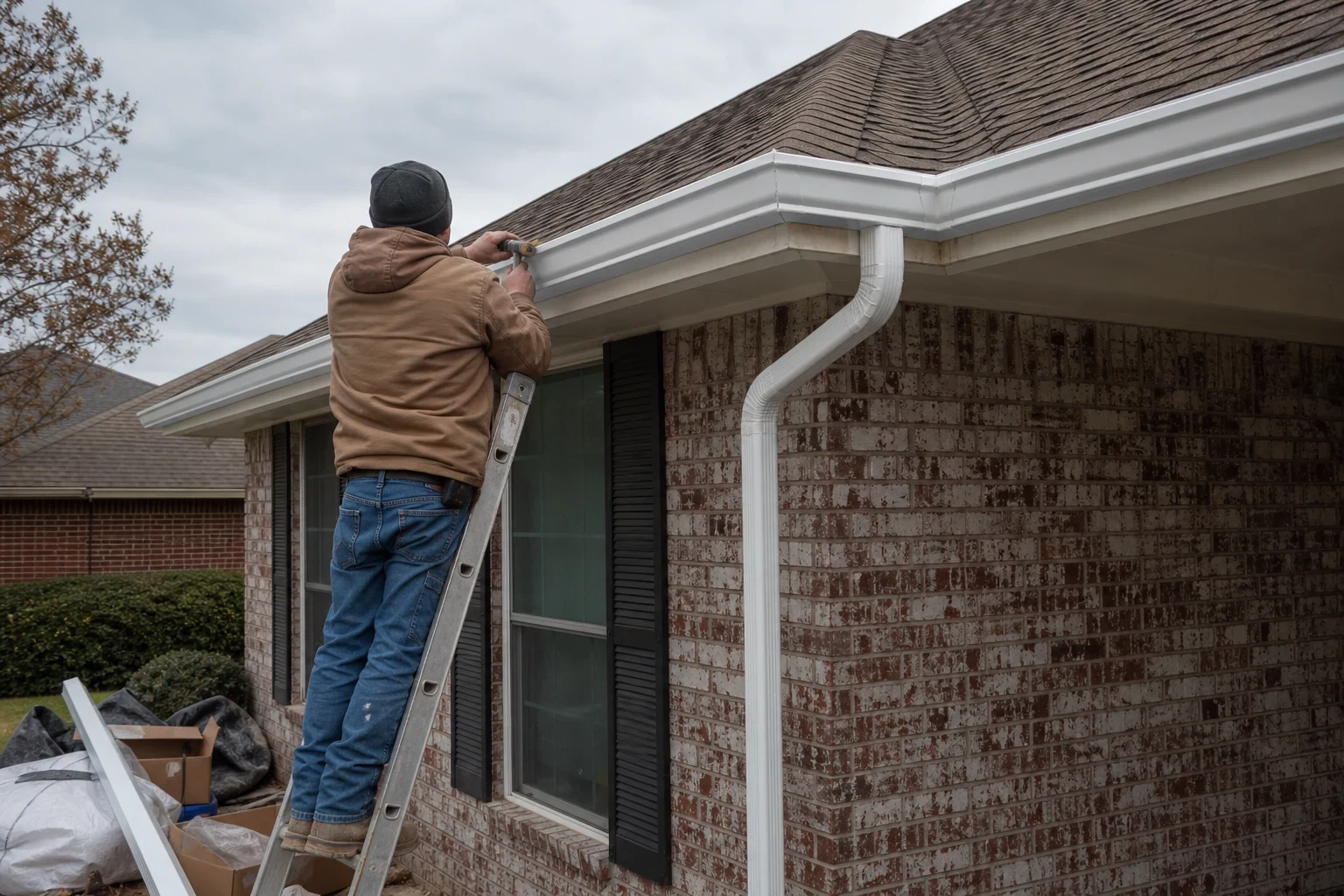
We form continuous aluminum gutters on site to match each eave of your home, and we fix the leaks, sags and clogs in the gutters you already have. Every run is pitched toward its downspout, fastened with hidden hangers and finished with your yard left the way we found it.
What Gutters Actually Do for Your Home
Gutters are the last part of your roof's drainage system. One inch of rain on a 2,000-square-foot roof is roughly 1,250 gallons of water. When a gutter overflows or a joint leaks, that water lands against the foundation, soaks the fascia board behind the gutter and splashes mud up the siding.
We install new continuous aluminum gutters, repair and reseal existing systems, and replace downspouts, hangers and end caps. With over 20 years of combined roofing experience, we treat gutters as part of the roof. That means checking the drip edge and fascia before anything gets hung, because a new gutter screwed into soft wood will pull loose within a season or two.
Gutter work happens directly above your flower beds, shrubs and walkways. We lay ground tarps under every run, keep ladders on standoffs so they never rest on the gutter or the shingles, and tell you before we start where the crew will park and work.
What Our Gutter Work Includes
One-piece runs formed on site
We feed aluminum coil through a forming machine in your driveway and cut each section to the exact length of the eave. Because the straight runs have no joints, the only seams are at corners and end caps, and those are the spots we seal.
Hidden hangers and correct pitch
Hidden hangers fasten through the gutter into the fascia about every two feet, which holds far better than old spikes and ferrules. We set a fall of about a quarter inch per ten feet toward each downspout so water drains instead of sitting and feeding rust or mosquitoes.
Downspouts placed where water can leave
We size downspouts to the roof area they serve and add extensions or splash blocks so the discharge lands several feet from the foundation, not in a flower bed against the wall.
Fascia and drip edge review
Our crew tests the fascia boards for decay and makes sure the drip edge tucks into the back of the gutter before any new run goes up. Any soft wood gets photographed and priced as its own item, so the choice to replace it stays with you.
Repairs and resealing
For gutters that are still sound, we reseal leaking corners, rehang sagging sections, replace crushed downspouts and correct pitch that has settled flat over the years.
Signs Your Gutters Need Attention
Overflow at the corners
Water sheeting over inside corners during a hard rain usually means the gutter is too small for the roof valley above it, or the downspout outlet is undersized.
Dips and gaps at the fascia
When a run bows down between fasteners or tips outward from the eave, the hangers are no longer gripping the wood. Water then pools in the low spot, and that extra weight pulls it down further with every storm.
Stains and peeling paint on fascia
Dark streaks or blistered paint behind the gutter mean water is getting behind it, often because the drip edge is missing or the gutter was hung too low.
Washouts and soggy soil at the foundation
Channels in the mulch, exposed roots or puddles along the slab point to downspouts that empty too close or joints that leak in the same spot every storm.
Dents from hail
Central Oklahoma's spring hail leaves dimples in aluminum gutters and downspouts. Dents alone may not stop drainage, but they are useful evidence if your roof was hit too, so photograph them before anything gets replaced.
How a Gutter Job Runs
- 1
Phone call and walk-around
You call and describe what you are seeing. We set a time to walk the perimeter, measure every run, check the fascia and note where water currently lands.
- 2
Written estimate you can read
You get a line-item estimate listing linear feet, gutter size, downspout count and any fascia repair. We go over it with you so nothing on the page is a mystery.
- 3
Install day
Tarps go down under each eave first. Old gutters come off, the fascia is fixed where needed, and the new runs are formed, hung and sealed. We let you know before any work near a door or the driveway so you can plan around it.
- 4
Water test and cleanup
We run a hose through each section to confirm it drains to the downspout, then haul away the old metal, sweep the driveway and magnet-sweep the lawn for screws and scraps.
What Moves the Cost of Gutters
Most of a gutter price comes from how much gutter your home needs and how hard each eave is to reach. Your written estimate breaks those pieces out one at a time, including footage, size, corners and any wood repair, so the total never shows up as a single unexplained number. Repairs are priced by the specific fix rather than as a partial replacement.
- Linear footage and height
- The total length of your eaves sets the material cost. A second story adds ladder setup and time, and narrow or sloped side yards slow the work further.
- Gutter size and gauge
- Five-inch K-style gutters suit many roofs, but steep pitches and long valleys often call for six-inch gutters with larger downspouts. Heavier-gauge aluminum costs more and holds up better against hail.
- Corners and downspouts
- Every inside or outside corner, end cap and downspout adds parts and sealing time. A house with many rooflines costs more than a plain rectangle with the same footage.
- Soft or rotted fascia
- New hangers need solid wood to bite into, so any decayed fascia board gets swapped out first. We can only judge how much once we test the boards on site, which is why that work shows up as a separate line you approve.
Gutter Questions We Hear Most
Something not covered here? (405) 870-2474
Do I need five-inch or six-inch gutters?
It depends on the roof area draining into each run and how steep the pitch is. Steeper roofs shed water faster, and at valleys that water can shoot past a smaller gutter. We measure each side of your home and tell you which size it needs, and why.
My roof is due for replacement soon. Is that a good time to do the gutters too?
Usually, yes. The gutters have to come down while the old shingles and drip edge are torn off, and new drip edge works best when it laps into a new gutter. If your current gutters are in good shape, we can remove them carefully and hang them back afterward. Our Roof Replacement page explains how we schedule both jobs together.
Hail dented my gutters. Is that an insurance claim?
It can be part of one, especially if the roof took hits in the same storm. We photograph the dents and walk you through what we saw on the gutters and the roof. Whether it is covered is your insurance company's call, not ours. Our Storm Damage Repair page explains how that process usually goes.
Are you licensed, and do you warranty the work?
We hold an Oklahoma residential roofing license. Gutter systems we install carry our lifetime workmanship warranty, which covers how the gutters are hung, pitched and sealed.
Will the crew damage my landscaping?
Tarps go down under every run before the old gutters come off. We keep ladders out of beds where we can and set them on boards where we cannot. If a plant is in the way, we ask you before moving anything.

Get Water Moving Away From Your Home
Tell us what happens at your gutters during a hard rain. We will walk the perimeter, measure every run and give you a written estimate that explains each line.